Xi Gui Hao
Mangfei Raw Pu-erh Tea Cake — 2023 Spring Lincang Sheng Pu-erh, Old-Growth Stone-Pressed 357g | Xi Gui Hao
Mangfei Raw Pu-erh Tea Cake — 2023 Spring Lincang Sheng Pu-erh, Old-Growth Stone-Pressed 357g | Xi Gui Hao
Couldn't load pickup availability
Quick Facts
| Tea Type | Raw Pu-erh Tea (Sheng Puerh) |
| Origin | Mangfei Village, Mengban, Yongde, Lincang, Yunnan |
| Elevation | ~1,500m (4,921 ft) |
| Harvest | 2023 Spring Harvest |
| Tree Age | Old-Growth Trees (~100 years) |
| Format | Traditional Stone-Pressed Cake — 357g |
This product is a traditional Chinese tea beverage. Individual experience may vary. Not intended to diagnose, treat, cure, or prevent any disease.
Mangfei Raw Pu-erh Tea — 2023 Spring Lincang Sheng Pu-erh, Old Tree Stone-Pressed Cake
In the deep mountains of Yongde County, Lincang, a tea has earned two nicknames that tell you everything: "Yongde Lao Banzhang" (永德老班章) and one of the "Lincang Four Dragons" (临沧四小龙) alongside Bingdao, Xigui, and Daxueshan. This is Mangfei — a raw pu-erh tea with a bold, bitter opening that resolves into one of the swiftest, most satisfying huigan in the entire pu-erh world. Strong tea character. Powerful structure. And a transformation across years that keeps collectors coming back.
Mangfei (忙肺) is an old-growth tea village in Mengban Township, Yongde County, Lincang, Yunnan — perched at approximately 1,500 meters on a mountain ridge surrounded by the Saimi River valley. The tea trees, approximately 100 years old, produce leaves that are remarkably fat and densely budded. Processing follows the traditional "Dian Shai Qing" (滇晒青) method: iron-wok hand-fixed (sha qing / 杀青), one-round hand-rolled, and naturally sun-dried in a single day. The leaves are then stone-pressed into 357g cakes — the classic format that has defined pu-erh trade since the Tea Horse Road era. The result is a sheng pu-erh tea cake that combines Lincang's rich sweetness with a structural intensity more commonly associated with Bulang Mountain. This is not a soft, gentle raw pu-erh — it's a tea with presence, with backbone, and with one of the most rewarding transitions from bitterness to sweetness you'll find.
"Yongde Lao Banzhang" & "Lincang Four Dragons" — What These Names Mean
Lao Banzhang (老班章) is the most famous bitter-bold pu-erh terroir in the world. Mangfei earned the nickname "Yongde Lao Banzhang" because it shares the same structural DNA: a direct, assertive bitterness on entry that transforms almost immediately into powerful, sustained huigan (pleasant aftertaste). The key difference? Mangfei offers this experience at a fraction of Lao Banzhang's price, with an additional layer of Lincang's signature honeyed sweetness underneath.
The title "Lincang Four Dragons" (临沧四小龙) places Mangfei in elite company: Bingdao (冰岛) for sweetness, Xigui (昔归) for minerality, Daxueshan (大雪山) for wild character, and Mangfei for bold structure and transformative aging. Among the four, Mangfei is the value play — the dragon that delivers the biggest punch per dollar.
About the name "Mangfei" (忙肺): Local tradition offers three explanations. The most widely told is a healing legend: three people suffering from lung disease were isolated near Dajian Mountain and survived by drinking wild tea — the village became known as "the place where tea healed lung disease." A second theory traces to the De'ang people, who called it "the fattest place" (最肥) for its exceptionally fertile soil and fat tea buds. A third, more scholarly account holds that Mangfei is a Dai-language geographic name meaning "mountain ridge between valleys" — a description of the village's actual location on a ridge above the Saimi River. All three capture something true: this is a special place.
Mangfei Sheng Pu-erh Tasting Notes
| Attribute | Description |
|---|---|
| Dry Leaf | Fat, tightly compressed strands with dense silver-white buds across the cake surface. Dark green and glossy with a noticeable oily sheen — a visual marker of the rich internal substances that drive Mangfei's exceptional longevity. The dry aroma is clean and crisp with a faint honeyed sweetness. |
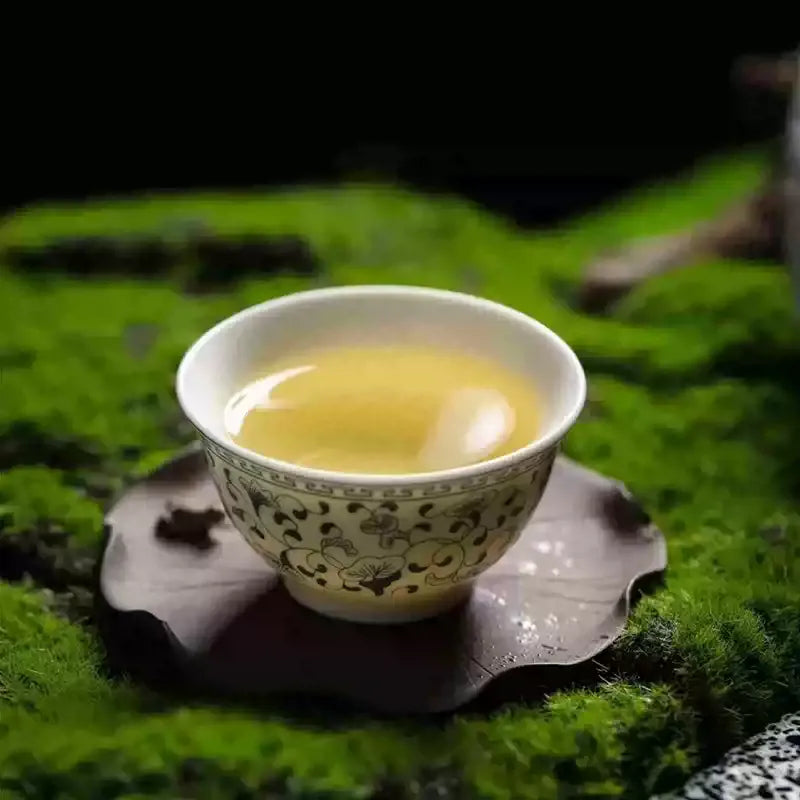
| Liquor | Golden-bright and translucent with a rich, oily viscosity. The tea heavily coats the glass — this is pectin-rich old-tree material expressing itself visually. As the session progresses, the color deepens slightly while maintaining clarity. |
| Aroma | Dominant honey-floral and plum fragrance (梅子香) — sweet and elegant, with strong penetration from the first pour. The cup-bottom fragrance is lasting and memorable. As the tea ages, some cakes develop a distinctive orchid note that adds another dimension to the aromatic profile. |
| Taste | A direct, assertive bitterness greets the tongue on entry, accompanied by a light astringency. But this is Mangfei's signature move: the bitterness resolves with remarkable speed — within seconds — transforming into a clean, sweet, full-flavored body. The transition from bitter to sweet is one of the most satisfying in any pu-erh tea. Each steep presents a clear structure: entry → bitterness → swift transformation → sweetness → lasting sweetness. |
| Mouthfeel | Full, thick, and substantial. The tea has a distinct tongue-pressing weight and a sticky, viscous quality that coats the entire mouth. It's bold without being harsh — a structured, satisfying presence that fills the palate completely. |
| Finish | This is where Mangfei earns its reputation. Huigan (pleasant aftertaste) arrives swiftly and powerfully — the sweetness surges back after the initial bitterness fades. Saliva production is generous and sustained. The throat feeling runs deep, and a clean, lasting sweetness persists for many minutes. The body sensation is notable: a distinctive warming feeling that many drinkers describe as penetrating and clarifying. |
| Longevity | 20+ infusions in gongfu style — among the most durable raw pu-erh teas available. The flavor remains remarkably stable across steeps rather than fading, a testament to the rich internal substances of Mangfei's old-tree leaves. Even the final rounds carry a pleasant sweetness and structural integrity. |
Who Is This Tea For?
- The Value-Focused Collector. Mangfei old-tree material delivers substance that rivals the most famous Lincang terroirs — Bingdao, Xigui — at a significantly more accessible price. Its aging trajectory is well-documented: the bitterness mellows, the body deepens, and the honey-plum character evolves into aged complexity. For collectors building a portfolio of aging pu-erh without paying famous-mountain premiums, Mangfei is one of the smartest allocations you can make.
- The After-Meal Drinker. Mangfei's bold, warming character makes it an exceptional post-meal tea. The strong body sensation — a distinctive warmth and gentle perspiration — is particularly satisfying after a heavy meal. Many drinkers specifically keep a Mangfei cake for this purpose.
- The Structure Seeker. If you chase teas with pronounced body sensation and depth — the kind that makes you pause mid-sip and pay attention — Mangfei delivers. It's the tea you reach for when you want the full experience, not just a gentle cup.
How Mangfei Compares to Other Lincang Teas
Mangfei belongs to the Lincang tea region alongside more famous names like Bingdao and Xigui. Here's how they compare:
| Terroir | Character | Bitterness | Aging Trajectory |
|---|---|---|---|
| Mangfei | Bold, structured, bitter→sweet transformation. Honey-plum aroma. 20+ infusions. | High — but resolves swiftly into sweetness | Excellent — 3-5yr golden window, 10+yr prime drinking |
| Bingdao | Soft, silky, extreme honey-sweetness. Gentle and approachable. | Almost none | Good — sweetens further but less dramatic structural change |
| Xigui | Rocky-mineral, complex, strong backbone with gentler entry | Moderate | Excellent — develops deep camphor-medicinal notes |
| Daxueshan | Wild, forest-floor, slightly smoky, untamed character | Moderate-high | Good — mellows significantly over 5+ years |
Mangfei's position is distinct: it's the boldest among the Four Dragons. If you find Bingdao too soft and Xigui too expensive, Mangfei offers a compelling third path — intensity, transformation, and value in equal measure.
Product Details
| Brand | Xi Gui Hao (昔归号) |
| Tea Type | Raw Pu-erh Tea (Sheng Puerh) |
| Vintage | 2023 Spring Harvest |
| Origin | Mangfei Village, Mengban Township, Yongde County, Lincang, Yunnan, China |
| Tree Age | Old-Growth Trees (~100 years) |
| Altitude | ~1,500m |
| Net Weight | 357g (12.59oz) |
| Format | Traditional stone-pressed cake — classic seven-son cake format |
| Processing | Traditional "Dian Shai Qing": iron-wok hand-fixed (sha qing / 杀青), hand-rolled, single-day sun-dried, stone-pressed |
How to Brew Mangfei Raw Pu-erh — New Tea vs Aged Tea
Mangfei's bold character rewards attention to brewing parameters. The approach differs significantly between young cakes (1–2 years) and aged ones (3+ years). Here's how to get the best cup at each stage:
🥬 New Tea (1–2 Years) — "Highlight Aroma, Suppress Bitterness"
- Vessel: White porcelain gaiwan (110–150ml) — fast heat dissipation, doesn't trap steam
- Temperature: 92–95°C — cool slightly from boiling, don't scald the young leaves
- Amount: 5–8g. Start at 5g if you're new to bold sheng or prefer lighter flavor
- Pour: Gentle, slow, along the wall — never blast the leaves directly
- Pour time: Fast — 5–10 seconds for first steeps. Pour and decant immediately
- Key technique — lift the lid: After each pour, remove the gaiwan lid to let heat escape. This prevents the leaves from stewing and releasing excess bitterness
- Later steeps: After 5–6 infusions, gradually increase steeping time by 3–5 seconds
🍂 Aged Tea (3+ Years) — "Wake the Tea, Release the Charm"
- Vessel: Yixing or purple clay pot — superior heat retention awakens aged character
- Temperature: 100°C boiling — aged leaves need maximum heat to fully express
- Amount: 6–8g — aged tea is mellower, so slightly more is fine
- Pre-warm & dry-wake: Rinse the pot with boiling water first. Add dry leaf, close lid, gently shake. Let the trapped heat wake the leaves for ~30 seconds. Open and smell — the aged fragrance will be captivating
- Rinse: 1 quick rinse (or 2 for 7+ year cakes) — boiling water, discard immediately
- Steeping: 10–15 seconds for early steeps — aged tea needs slightly more time to release
- Keep warm: Close the lid after each pour to maintain pot temperature
💡 Universal tip — dry-wake before brewing: Whether your cake is new or aged, break off the amount you need and let it rest in a tea caddy (unglazed clay or porcelain) for 3–7 days before brewing. This gentle air contact allows any storage odors to dissipate and the leaf fragrance to bloom — your first steep will be noticeably cleaner and more aromatic.
Simple Mug Style
Break off ~3g, add to a 300ml mug with 90–95°C water, steep 1–2 minutes. Refill 3–4 times. Mangfei's bitterness is more pronounced in mug brewing — if you prefer a gentler cup, use slightly cooler water (around 90°C) and a shorter steep.
Drinking Notes — Getting the Best From Mangfei
- Sensitive stomach? Mangfei's bold character can be stimulating on an empty stomach. Best enjoyed 30+ minutes after a meal.
- Caffeine-aware? Mangfei is notably awakening — those sensitive to caffeine should plan their session for morning or early afternoon.
- New to bold sheng? Start with 5g, fast pours, and slightly cooler water (90–92°C). You'll experience the honey-plum fragrance and huigan without being overwhelmed by bitterness. You can always increase the intensity next time.
How to Store (Aging Potential)
Store in a cool, dry, well-ventilated place away from direct sunlight and strong odors. Ideal storage conditions: temperature 20–25°C (68–77°F), relative humidity 55–65%. Keep sealed in the original cotton paper wrapper or transfer to a breathable kraft paper bag or unglazed clay jar.
Mangfei's aging trajectory is one of the most rewarding among Lincang raw pu-erh teas. Here's what to expect:
| Stage | What Changes | Experience |
|---|---|---|
| 1–3 Years | Fresh floral notes remain high. Honey aroma dominant. Bitterness and astringency still present but integrating. | Bold, structured, powerful huigan — the classic Mangfei experience. Drink for the intensity. |
| 3–5 Years | Honey transitions to aged character. Bitterness recedes significantly. Body becomes thicker and smoother. | The golden drinking window begins — structured but mellowed, complex but accessible. |
| 5–10 Years | Aged fragrance and subtle medicinal notes emerge. Liquor thickens to almost rice-soup texture. Sweetness deepens. | Collectors' sweet spot — character, depth, and rarity appreciation align. |
| 10+ Years | Medicinal and woody notes fully developed. Tea character becomes gentle and warming. Silky-smooth body. | Prime drinking period — the full arc of Mangfei's transformation is now expressed. |
Suitable for long-term aging when stored properly.
Mangfei Raw Pu-erh Tea — Frequently Asked Questions
Why is Mangfei called one of the "Lincang Four Dragons"?
The "Lincang Four Dragons" (临沧四小龙) — Bingdao, Xigui, Daxueshan, and Mangfei — are recognized as the four pinnacle terroirs of the Lincang tea region. Mangfei earned its place through its bold, structured character, exceptional huigan, and remarkable aging potential — qualities that place it alongside far more expensive famous-mountain teas while remaining accessible to serious drinkers.
Does Mangfei really taste like Lao Banzhang?
The comparison is real. Both share a direct, assertive bitterness that resolves swiftly into powerful, sustained huigan — the classic "bitter entry, sweet finish" structure. Lao Banzhang's bitterness is sharper and more aggressive; Mangfei's is slightly rounder, with an underlying honeyed sweetness that reflects its Lincang origins. Many experienced drinkers find Mangfei's version of the bold-sweet arc more balanced and approachable, especially after 3–5 years of aging.
Should I drink this now or age it?
Both. A 2023 cake has had 2–3 years to settle — the most aggressive bitterness has already begun to soften while the honey-plum fragrance is still vibrant. Drink some now to experience Mangfei's bold young character, and set aside the rest. At 5 years (2028), you'll have a markedly different tea — smoother, deeper, with the bitterness transformed into aged complexity. The best approach: buy two cakes. One for now. One for later.
About caffeine in pu-erh: Like all real teas, raw pu-erh contains natural caffeine — actual caffeine content varies by brewing method, leaf-to-water ratio, and steeping time. Mangfei is notably awakening; those sensitive to caffeine may wish to enjoy it in the morning or early afternoon. Natural & Handcrafted: This product is made from natural tea leaves, hand-picked, iron-wok hand-fixed (sha qing / 杀青), hand-rolled, and sun-dried using the traditional "Dian Shai Qing" method in Yunnan, China. It contains no artificial additives, flavorings, or preservatives. All aroma and flavor characteristics are the natural result of the tea's high-altitude growing environment and traditional processing methods. This product is a traditional tea beverage and is not intended to diagnose, treat, cure, or prevent any disease.
Share