Xi Gui Hao
Nahan "Gentleman Among Teas" — 2025 Spring Bangdong Sheng Pu-erh, Old-Growth Cake & Loose Leaf | Xi Gui Hao
Nahan "Gentleman Among Teas" — 2025 Spring Bangdong Sheng Pu-erh, Old-Growth Cake & Loose Leaf | Xi Gui Hao
Couldn't load pickup availability
Quick Facts
| Tea Type | Raw Pu-erh Tea (Sheng Puerh) |
| Origin | Nahan Village, Bangdong, Linxiang, Lincang, Yunnan |
| Elevation | ~1,500m (4,921 ft) |
| Harvest | 2025 Spring Harvest |
| Tree Age | Old-Growth Trees (~200 years) |
| Format | Stone-Pressed Cake 357g / Loose Leaf 50g |
This product is a traditional Chinese tea beverage. Individual experience may vary. Not intended to diagnose, treat, cure, or prevent any disease.
Nahan Raw Pu-erh Tea — 2025 Spring Bangdong Sheng Pu-erh, Old-Tree Stone-Pressed Cake
In 1828, a local scholar presented a tea to the Daoguang Emperor. The Emperor tasted it and offered a verdict that would echo through two centuries: "Though its color is light, its aftertaste is rich and mellow — like the quiet depth of a gentleman's friendship." That tea came from Nahan (那罕), a village perched on the rocky slopes of Bangdong Mountain in Lincang, Yunnan. It earned the title "Gentleman Among Teas" (茶中君子) and served as tribute tea for twelve consecutive years. Today, Nahan's signature — "rock-bone orchid fragrance" (岩骨兰香) — remains one of the most distinctive flavor profiles in the pu-erh world: orchid elegance built on mineral structure, with a transformation from bitter to sweet that unfolds like a story in every cup.
Nahan sits at approximately 1,500 meters in the Bangdong (邦东) range of Lincang — the same tea region that produces Xigui (昔归), one of pu-erh's most famous and expensive mountains. The tea trees, approximately 200 years old, grow wedged into rocky crevices and gravelly soil — their roots absorbing minerals from the sandstone and conglomerate that make up Bangdong's geology. The leaves are the classic Bangdong large-leaf variety: long, slender "willow-leaf" shaped (柳叶形), hand-picked at dawn by the "one bud, two leaves" standard. Processing follows traditional sun-dried methods: iron-wok hand-fixed (sha qing / 杀青), hand-rolled while warm, and sun-dried in a single day. The cakes are stone-pressed in the traditional manner. No shortcuts. No machine processing. Just the mountain, the rocks, and two centuries of tea-making knowledge.
"Rock-Bone Orchid Fragrance" — The Soul of Nahan Tea
"Rock-bone orchid fragrance" (岩骨兰香) is one of the most evocative phrases in Chinese tea culture — and it describes Nahan perfectly. The "rock-bone" (岩骨) refers to the structural backbone of the tea: a full, dense body with real presence — not a thin, fleeting cup, but one with weight and substance. It comes from the tea trees growing in mineral-rich rocky soil, absorbing what the mountain offers. The "orchid fragrance" (兰香) is the high, clear, elegant floral note that rises from the cup — not applied, not added, but grown into the leaf over decades of life on Bangdong's slopes.
What makes this combination rare is that most teas are either "structured" or "fragrant" — rarely both. Nahan integrates them: the minerality anchors the floral notes, and the floral notes lift the minerality. The result is a tea that's simultaneously elegant and substantial, delicate and grounded. It is the closest thing in raw pu-erh to the experience of a fine Wuyi rock oolong (岩茶) — which is why the comparison to "rock-bone" is not hyperbole but an accurate description of what Nahan actually tastes like.
The olive analogy: Nahan's tasting experience is often compared to eating fresh Chinese olives (青橄榄). The first moment brings a clean bitterness — but that bitterness resolves almost instantly into a wave of returning sweetness and saliva that fills the entire mouth. The bitterness is not a flaw; it's the opening act of the sweetness that follows. Without it, the sweetness wouldn't feel as earned or as satisfying.
"Gentleman Among Teas" — A Tribute Tea with Imperial Provenance
During the Daoguang and Xianfeng reigns of the Qing Dynasty (1821–1861), Nahan tea was selected as tribute tea for twelve consecutive years — an extraordinary run that speaks to its consistent quality. The most famous account dates to 1828, when Yang Guohan (杨国翰), a scholar from Yunnan who had passed the imperial examination, presented Nahan tea to the Daoguang Emperor. After tasting it, the Emperor remarked: "Though its color is light, its aftertaste is rich and mellow — like the quiet depth of a gentleman's friendship" (虽颜色浅淡,但回味甘醇,如君子之交淡如水). From that moment, Nahan became known as the "Gentleman Among Teas."
The Emperor's description was perceptive. Nahan is not a tea that overwhelms you on first contact the way Lao Banzhang does. It reveals itself gradually — the bitterness arrives first, then recedes; the sweetness builds rather than announces; the orchid fragrance settles into the tea body rather than floating above it. Like a gentleman, it doesn't demand attention. It earns it.
Nahan Sheng Pu-erh Tasting Notes
| Attribute | Description |
|---|---|
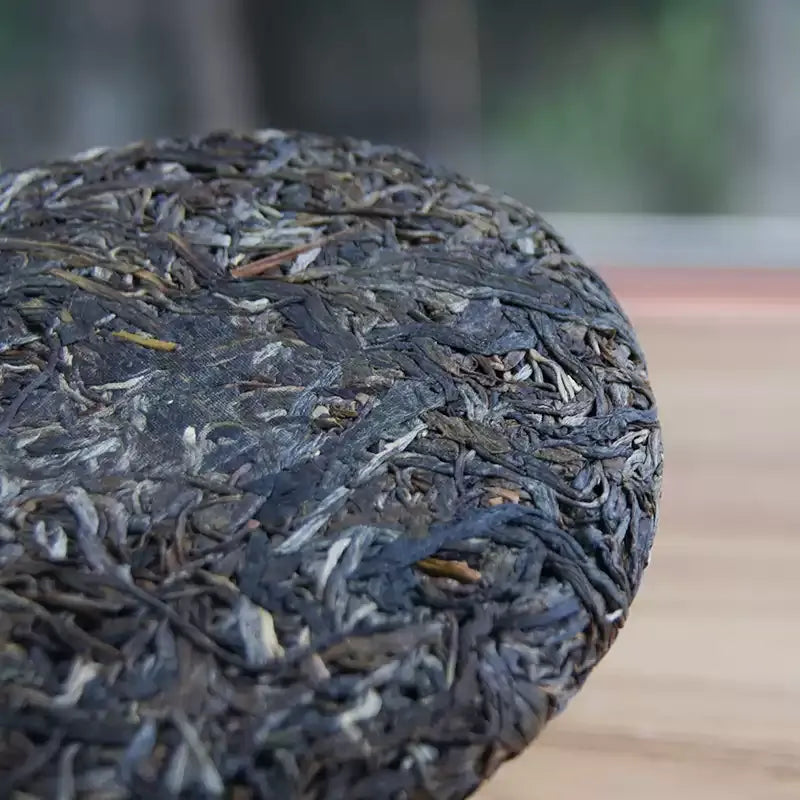
| Dry Leaf | Plump, elongated strands in the classic Bangdong "willow-leaf" shape — long and slender with a pronounced elegant curve. Dark green and glossy with a noticeable oily sheen. The dry aroma carries a faint, clean sweetness with a whisper of cool minerality. |
| Liquor | Bright golden-yellow when young, gradually shifting to orange-gold with aging. Crystal clarity with excellent gloss. The tea has visible substance — it coats the cup with a silky film that signals pectin-rich old-tree material. |
| Aroma | The signature "rock-bone orchid fragrance" — a distinctive, highly recognizable profile. Unlike Xigui's soaring, outward-facing orchid, Nahan's orchid is woven into the body of the tea itself — quiet, deep, and integrated. Supporting notes of honeyed sweetness and wild mountain character add complexity. The aroma is not separate from the taste; it's part of the same experience. |
| Taste | Like eating a fresh olive: a clean, direct bitterness greets the tongue on entry, but it resolves with remarkable speed — within seconds — transforming into a generous, mouth-filling sweetness and sustained saliva production. The bitterness and sweetness are not opponents; they are partners in a single, layered experience. The bitterness gives the sweetness meaning. This "bitter-sweet interplay" (苦甜交织) is the structural core of Nahan's flavor architecture. |
| Mouthfeel | Full and substantial with a clear viscosity and sticky mouth-coating quality. Despite the density, the texture remains remarkably fine and delicate — a smooth, silky fineness that belies the tea's structural weight. This is the "soft exterior, hard interior" (柔中带刚) that defines Nahan's mouthfeel character. |
| Finish | Swift and lasting. By the third infusion, the tongue and throat are wrapped in a deep, resonant sweetness. Saliva production is generous and sustained. The throat feeling is clear and pronounced — a hallmark of quality Bangdong material. The aftertaste lingers, clean and satisfying, with the orchid note returning in the empty cup. |
| Longevity | 15–20 infusions in gongfu style — the rich internal substances of the rocky Bangdong terroir sustain the tea through an extended session. The late steeps settle into a clean, cooling sweetness with no fatigue — the "tail water" is crisp and refreshing, a final reminder of Nahan's mineral foundation. |
Who Is This Tea For?
- The Complexity Seeker. If you enjoy teas that unfold rather than announce — where the bitterness leads somewhere, the fragrance hides in the body, and each infusion reveals a new layer — Nahan is a tea you'll return to. Its "rock-bone orchid" profile is one of the most intellectually satisfying experiences in raw pu-erh. This is a tea for slow, attentive sessions.
- The Bangdong Explorer. Xigui is famous. Nahan is its quieter neighbor — sharing the same terroir, the same rocky soil, the same orchid DNA, but expressing it with more subtlety and finesse. If you've tasted Xigui and want to understand the full range of what Bangdong can produce, Nahan is the essential next step. And it delivers this education at a fraction of Xigui's price.
- The Aging Collector. Nahan's rich internal substances, mineral foundation, and balanced structure make it an excellent candidate for long-term aging. Over years, the bitterness will soften, the orchid will deepen into honeyed-aged complexity, and the body will grow ever silkier. This is a tea to buy two of: one for now, one for later.
How Nahan Compares to Other Famous Pu-erh Mountains
Nahan's position in the pu-erh landscape becomes clearer when placed alongside its peers:
| Terroir | Signature Character | Bitterness Profile | Position |
|---|---|---|---|
| Nahan | Rock-bone orchid, bitter-sweet interplay, soft exterior with hard interior | Direct bitterness → swift sweet return. Structured but balanced | Bangdong's refined value — gentleman, not warrior |
| Xigui (昔归) | Bold, aggressive entry, soaring orchid, powerful body sensation | Strong upfront impact, commanding character | Bangdong's flagship — "Lincang Lao Banzhang" |
| Bingdao (冰岛) | Pure rock-sugar sweetness, cooling throat charm, zero bitterness | Almost none — pure sweetness | Lincang's sweet extreme — "Pu-erh Queen" |
| Mangfei (忙肺) | Bold bitterness, explosive huigan, "Yongde Lao Banzhang" | Strong and aggressive — ages best | Lincang's power play — best with age |
| Lao Banzhang | King of pu-erh — fierce bitterness, thunderous huigan, overwhelming body | Extreme — the benchmark of bitterness | Bulang's apex — power above all |
| Yiwu (易武) | Soft, sweet, rounded — gentle and approachable | Very low — "soft and sweet" character | Southern Yunnan's gentle side |
Nahan's unique place: it combines Bangdong's mineral structure with a finesse that the bolder Bangdong teas (Xigui) don't always show. It is not the most powerful, nor the sweetest, nor the most famous — but it may be the most balanced, and for many, the most rewarding to drink deeply.
Product Details
| Brand | Xi Gui Hao (昔归号) |
| Tea Type | Raw Pu-erh Tea (Sheng Puerh) |
| Vintage | 2025 Spring Harvest |
| Origin | Nahan Natural Village, Mangang, Bangdong Township, Linxiang District, Lincang, Yunnan, China |
| Tree Age | Old-Growth Trees (~200 years) |
| Altitude | ~1,500m |
| Net Weight | 357g (12.59oz) Cake / 50g (1.8oz) Loose Leaf |
| Format | Traditional stone-pressed cake — Bangdong large-leaf variety, "willow-leaf" shape |
| Processing | Dawn hand-picked (one bud, two leaves), iron-wok hand-fixed (sha qing / 杀青), hand-rolled, sun-dried, stone-pressed |
How to Brew Nahan Raw Pu-erh Tea
Gongfu Style (Recommended)
- Vessel: Porcelain gaiwan, 120–150ml — neutral material best reveals Nahan's rock-bone orchid character
- Amount: 8g
- Temperature: 95–100°C (203–212°F)
- Key step — wet-wake (润茶): Pour boiling water in a low, covering stream to saturate the leaves. Decant immediately and open the lid to let heat escape. This "wakes" the mineral character without trapping excess bitterness
- Steeping: First 3–4 infusions: pour boiling water in a high, targeted stream — 5–10 seconds, quick decant. After steep 4, extend by 5–10 seconds per round. The aroma evolves: orchid-like in early steeps, deeper and more mineral in later rounds. 15–20 infusions achievable
Simple Mug Style
Add 3g to a mug with boiling water, steep 3–5 minutes. Top up as you drink — the "leave-root" method. Nahan's mineral backbone means the flavor stays clean and satisfying through multiple refills.
How to Store (Aging Potential)
Store in a dry, cool, odor-free environment away from direct sunlight. Ideal: temperature 20–25°C (68–77°F), relative humidity 55–65%. Keep in the original cotton paper wrapper or a breathable kraft paper bag. If your storage environment is very dry (<45% RH), place a small cup of water nearby to maintain gentle humidity — extreme dryness will stall the aging process.
| Stage | What to Expect |
|---|---|
| 1–3 Years | Orchid fragrance high and vibrant. Tea has strong vitality and impact — bitterness still present but huigan swift and rewarding. Drink for the energy and freshness. |
| 3–6 Years | The golden drinking window opens. Aroma integrates more fully into the body. Rock-bone orchid becomes more mellow and grounded. Bitterness softens; the mouthfeel grows rounder and fuller. |
| 6–10 Years | Body reaches peak thickness. Sweetness deepens. Aged character emerges alongside the rock-bone orchid — a complex, layered experience unique to aged Nahan. |
| 10+ Years | Tea character becomes gentle and warming. Body grows ever silkier, with a settled aged charm and enduring vitality. |
Suitable for long-term aging when stored properly.
Nahan Raw Pu-erh Tea — Frequently Asked Questions
What is "rock-bone orchid fragrance" — does the tea actually taste like rocks?
No — "rock-bone" (岩骨) describes the tea's structural backbone: a full, dense body with real presence and weight. It's not a literal rock taste. This character comes from Nahan's tea trees growing in rocky crevices and gravelly soil, where their roots absorb minerals from Bangdong's sandstone geology. The "orchid fragrance" is the elegant floral note woven into this structure. Together, they create a tea that's simultaneously substantial and refined — structured like a rock oolong, fragrant like a fine raw pu-erh.
How is Nahan different from its famous neighbor, Xigui?
Both are Bangdong teas sharing the same terroir, but their expression is different. Xigui's orchid is soaring and assertive — it announces itself. Nahan's orchid is quieter, woven into the tea body rather than floating above it. On entry, Xigui is bold and commanding; Nahan is softer, more refined, revealing its character through the bitter-sweet transformation rather than upfront impact. Xigui is the warrior. Nahan is the gentleman. Both are excellent — they simply speak at different volumes.
What does the "olive taste" comparison mean?
This is a classic way Chinese tea drinkers describe Nahan's unique bitter-sweet arc. Like eating a fresh Chinese olive (青橄榄): the first taste is a clean bitterness, but that bitterness transforms rapidly into a wave of returning sweetness and saliva that fills the mouth. The bitterness isn't a defect — it's the necessary opening act for the sweetness that follows. Without the bitterness, the sweetness wouldn't feel as earned or as deeply satisfying.
About caffeine in pu-erh: Like all real teas, raw pu-erh contains natural caffeine — actual caffeine content varies by brewing method, leaf-to-water ratio, and steeping time. Natural & Handcrafted: This product is made from natural tea leaves, hand-picked at dawn, iron-wok hand-fixed (sha qing / 杀青), hand-rolled, and sun-dried using traditional methods in Yunnan, China. It contains no artificial additives, flavorings, or preservatives. The orchid fragrance and mineral character are the natural result of the tea's rocky growing environment and traditional processing. This product is a traditional tea beverage and is not intended to diagnose, treat, cure, or prevent any disease.
{ "@context":"https://schema.org","@type":"Product", "name":"2025 Nahan Old Tree Raw Pu-erh Cake 357g", "description":"Nahan 2025 Spring Sheng Pu-erh Cake — rock-bone orchid fragrance with swift bitter-to-sweet transformation. ~200yr old trees, Bangdong Lincang. 357g.", "brand":{"@type":"Brand","name":"Xi Gui Hao"}, "category":"Tea & Infusions", "image":"[REPLACE_WITH_MAIN_PRODUCT_IMAGE_URL]", "offers":{"@type":"Offer","availability":"https://schema.org/InStock","price":"[REPLACE_WITH_PRICE]","priceCurrency":"USD","itemCondition":"https://schema.org/NewCondition"} } { "@context":"https://schema.org","@type":"FAQPage", "mainEntity":[ {"@type":"Question","name":"What is rock-bone orchid fragrance — does the tea actually taste like rocks?","acceptedAnswer":{"@type":"Answer","text":"No. Rock-bone describes the tea's structural backbone — a full, dense body from minerals absorbed through rocky Bangdong soil. The orchid fragrance is the elegant floral note woven into this structure. Together they create a tea that is simultaneously substantial and refined."}}, {"@type":"Question","name":"How is Nahan different from its famous neighbor, Xigui?","acceptedAnswer":{"@type":"Answer","text":"Both are Bangdong teas. Xigui's orchid is soaring and assertive; Nahan's is quieter and woven into the body. Xigui enters boldly; Nahan is softer and more refined, revealing character through bitter-sweet transformation. Xigui is the warrior, Nahan the gentleman."}}, {"@type":"Question","name":"What does the olive taste comparison mean?","acceptedAnswer":{"@type":"Answer","text":"Like eating a fresh Chinese olive: the first taste is a clean bitterness that rapidly transforms into a wave of returning sweetness and saliva. The bitterness is the opening act for the satisfying sweetness that follows."}} ] }
Share