Xi Gui Hao
2025 Xigui Lincang Single-Tree Ancient Raw Pu-erh / Sheng Puerh Loose Leaf 50g | Xi Gui Hao
2025 Xigui Lincang Single-Tree Ancient Raw Pu-erh / Sheng Puerh Loose Leaf 50g | Xi Gui Hao
Couldn't load pickup availability
In the world of raw pu-erh tea, altitude is almost everything — the highest peaks command the highest prices, the oldest trees at the greatest heights are the stuff of legend. And then there is Xigui (昔归), sitting at just 750 meters above sea level on the banks of the Lancang River, producing ancient tree pu-erh that rivals and often surpasses teas grown at three times its elevation. This 2025 spring harvest takes it one step further: a single-tree picking from one ancient tree on Manglu Mountain. No blending. No compromise. Just the pure fingerprint of one tree, one mountain, one season.
Xigui sits in a unique micro-pocket within Bangdong Township, Lincang — where morning mist rolls in from the Lancang River and burns off by late morning, creating a natural temperature regulation that no high-altitude garden can replicate. The ancient tea trees here, some exceeding 500 years, dig deep into mineral-rich red soil, absorbing a complexity that expresses itself in every cup of this single-origin raw pu-erh. These trees have never been pruned. Never fertilized. They grow at nature's pace, producing thick, leathery leaves with pronounced serrated edges — a signature trait of authentic Xigui ancient tree material. The 2025 spring season delivered ideal conditions: a dry March for concentration, followed by timely April rains for fullness. The result is a sheng puerh that captures Xigui at its most expressive.
The Xigui Anomaly — What Makes Low-Altitude Raw Pu-erh Taste This Good
Pu-erh drinkers speak of a "King and Queen" — Lao Banzhang as the King, Bingdao as the Queen. But there is a third force: Xigui, the anomaly. Where other famous mountains derive their character from altitude and thin mountain air, Xigui draws its power from the Lancang River. The daily mist cycle, the rich red soil, and the unique solar exposure of its south-facing slopes create a raw pu-erh tea that is simultaneously bold and gentle, mineral-driven yet honey-sweet. It is the only famous pu-erh terroir where 750-meter trees produce material that collectors rank alongside 1,800-meter giants. And within Xigui, nothing is more coveted than a single-tree harvest — tea from one individual ancient tree, unblended, capturing the exact character of that tree's root system, that tree's microclimate, that tree's singular expression of place.
2025: A return to ideal conditions. After several years of climate variability across Yunnan, the 2025 spring in Xigui was textbook — a dry, cool March that concentrated the buds' energy, followed by steady, moderate April rains that drew fullness and depth from the deep root systems. Ancient trees responded with some of the most balanced, aromatic leaf in recent memory. This single-tree sheng puerh captures that moment — a vintage that Xigui collectors will remember.
What does "single tree" mean? Single tree (单株 / dan zhu) means the leaves in this pressing come from one individual ancient tea tree — not a garden blend, not a multi-tree plot. In the same way that single-barrel whisky captures the character of one cask, single-tree pu-erh captures the exact fingerprint of one tree's root system, microclimate, and genetic expression. It is the purest possible expression of a terroir, and it is rare — most Xigui productions blend leaves from multiple trees across the mountain. A single-tree cake from a 500+ year old tree is a collector's item.
Xigui Single Tree Sheng Pu-erh Tasting Notes — 2025 Vintage
| Attribute | Description |
|---|---|
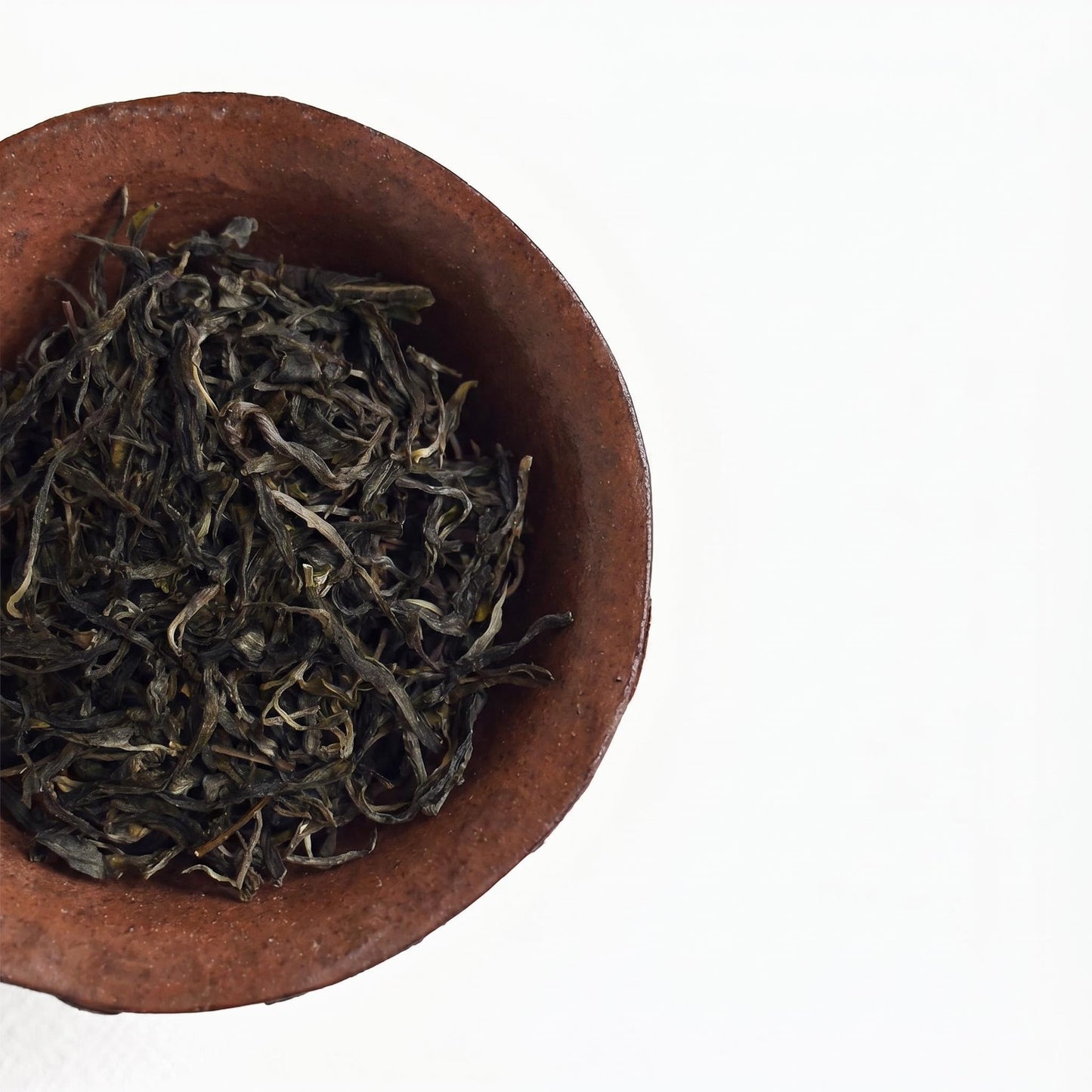
| Dry Leaf | Intact, thick strips — glossy black-green with prominent silver tips densely covering the surface. The leaves are large and leathery with pronounced serrated edges, a signature of authentic Xigui ancient tree material. The dry aroma is complex and restrained: wild honey, dried longan, and sun-warmed hay, with a faint cooling minerality already detectable. |
| Liquor | Bright golden-amber, crystal clear from first steep to last. A heavy, persistent oil ring clings to the cup edge — the visual signature of pectin-rich ancient tree leaf. The liquor coats the glass with the viscosity of warm honey. |
| Aroma | Layered and evolving. Opens with high-floral notes — wild orchid and osmanthus — that rise from the cup the moment hot water hits the leaf. As the session progresses, the florals give way to ripe stone fruit and finally settle into a deep, resonant wild orchid honey. The empty cup leaves a long-lasting honey-cool fragrance. |
| Taste | Sweetness leads — sugarcane and crystalline rock sugar on the first sip — followed by a wave of tropical fruit character: ripe mango and lychee. This is framed by Xigui's signature mineral backbone, a rocky, almost spring-water clarity that prevents the sweetness from ever feeling heavy. There is virtually no bitterness, only a clean, structured sweetness that holds steady across every infusion. |
| Mouthfeel | Silky, full-bodied, and remarkably thick. The tea coats every surface of the mouth with a lubricating, almost creamy texture. By the third infusion, the Xigui "throat resonance" (喉韵 / hou yun) arrives: a deep, cooling sensation that begins in the throat and spreads downward, lingering long after swallowing. This is the hallmark of genuine ancient tree Xigui raw pu-erh. |
| Finish | Enduring huigan (huigan, returning sweetness) that builds for minutes rather than seconds. Saliva production is generous and sustained. The aftertaste carries wild honey, rock sugar, and a clean mineral coolness — the "cooling charm" that Xigui shares, in its own way, with Bingdao. Fifteen minutes after the final sip, the throat still holds a faint, sweet coolness. |
| Longevity | 12–15 full infusions in gongfu style. The tea does not fade — it transforms. Early steeps showcase floral complexity; middle steeps deliver the sweetness peak and throat resonance; late steeps become pure, clean, honey-sweet water. A raw pu-erh that rewards patience across a full session. |
"Lao Banzhang is the dominance of Menghai; Bingdao is the sweetness of Lincang; Xigui is the dominance and the sweetness of Lincang."
Who Is This Tea For?
- The Pu-erh Connoisseur Seeking the Complete Picture. You've tasted Bulang. You've collected Bingdao. You know Lao Banzhang. Xigui — and specifically Xigui single-tree — is the missing piece. A terroir that defies altitude conventions, an ancient tree that has stood for half a millennium, a raw pu-erh tea that delivers both the bold mineral backbone of Menghai and the honeyed sweetness of Lincang in a single cup. This is not a tea for filling a collection gap — it's a sheng puerh that redefines what you thought pu-erh could be.
- The Collector Tracking a Rising Legend. Xigui's reputation has climbed steadily over the past decade as more drinkers discover its unique low-altitude-high-quality paradox. Single-tree pressings are among the rarest productions from this region. A 2025 single-tree raw pu-erh, from an ideal spring harvest, pressed by a family with roots in Xigui dating to 1900 — this is a vintage worth cellaring. Track its evolution across 5, 10, 20 years of proper storage.
- The Gift Giver Who Won't Settle for Generic. When a standard gift box feels hollow, this tea tells a story. It's a conversation piece — a low-altitude miracle, a single ancient tree, a family legacy stretching back over a century — that unfolds across every infusion. The recipient isn't just drinking tea; they're experiencing a piece of Yunnan pu-erh history.
How Xigui Compares to Other Famous Pu-erh Mountains
Xigui, Bingdao, and Lao Banzhang are three of the most sought-after raw pu-erh terroirs in Yunnan — but each expresses a completely different character:
| Terroir | Character | Sweetness | Aging Arc |
|---|---|---|---|
| Xigui | Mineral-driven, structured, honey-sweet — the "Low-Altitude Miracle" | High — wild honey and rock sugar, supported by a clean mineral backbone | 3–5yr: florals settle, minerals deepen. 8–12yr: camphor notes emerge. 15yr+: full integration |
| Bingdao | Elegant, silky, cooling throat charm — "Pu-erh Queen" | Extreme — crystalline rock-sugar sweetness, pure and unwavering | 10yr: golden drinking window. 20yr+: legendary status |
| Lao Banzhang | Bold, aggressive, powerful bitterness → explosive huigan — "Pu-erh King" | Moderate — overshadowed by structural intensity | 5–10yr: bitterness softens. 15yr+: full integration |
Xigui occupies a singular position: it delivers the structural power that Lao Banzhang lovers crave, combined with the honeyed sweetness that draws people to Bingdao — but expressed through a distinctly mineral, rocky lens that belongs to no other mountain. It is the raw pu-erh tea for drinkers who want both strength and sweetness, backbone and charm, all in one cup.
Product Details at a Glance
| Brand | Xi Gui Hao (昔归号) |
| Tea Type | Raw Pu-erh Tea (Sheng Puerh) |
| Harvest | 2025 Spring Harvest — First Flush |
| Origin | Manglu Mountain, Xigui Village, Bangdong Township, Lincang, Yunnan, China |
| Elevation | ~750m (2,460 ft) |
| Tree Age | Ancient Tree (500+ years) |
| Picking Standard | Single tree harvest — one bud with 2–3 leaves, hand-picked at dawn |
| Processing | Traditional "Dian Shai Qing" (滇晒青): dawn hand-picked → iron-wok hand-fixed (sha qing / 杀青, <180°C) → hand-rolled while warm → single-day sun-dried → stone-pressed |
| Format | Traditional stone-pressed cake / Loose leaf |
| Storage | Dry storage (干仓), Yunnan — controlled conditions since harvest |
How to Brew Xigui Single Tree Raw Pu-erh Tea
Gongfu Style (Recommended)
- Vessel: Porcelain gaiwan, 100–120ml — or Yixing clay pot (yixing clay, purple sand teapot) to deepen the mineral character
- Ratio: 5g to 100–120ml gaiwan
- Temperature: 100°C (212°F) — Xigui's thick, waxy ancient tree leaves demand full boiling water for full expression
- Rinse: 1 quick flash rinse — pour boiling water, decant immediately. This "wakes" the leaf after pressing
- Steeping: Steeps 1–3: 10–15 seconds — floral explosion. Steeps 4–8: 15–25 seconds — sweetness peak, throat resonance builds. Steeps 9–15: 30–60 seconds — minerality dominates, still honey-sweet. Pay attention to the throat — the cooling sensation builds across infusions and lingers long after the session ends.
Simple Mug Style
Break off ~3g, add to a mug with 100°C boiling water, steep 3–4 minutes. Refill with hot water 2–3 times as you drink — the leaves will continue to release sweetness across multiple refills. Xigui's structured character makes this ancient tree raw pu-erh remarkably forgiving of casual brewing.
Cold Brew: 4g leaf in 500ml cold water. Refrigerate 6–8 hours (overnight works beautifully). Strain and serve over ice. The cold extraction amplifies Xigui's honey sweetness and mineral clarity — an exceptionally refreshing way to experience this sheng puerh in warm weather.
Pro tip: For best results, break off the amount you need and let it rest in a tea caddy for 3–7 days before brewing — this gentle air contact allows the leaf fragrance to bloom fully after pressing.
How to Store (Aging Potential)
Store in a cool, dry, well-ventilated place away from direct sunlight and strong odors. Ideal storage conditions: temperature 20–25°C (68–77°F), relative humidity 55–65%. Keep in the original cotton paper wrapper or transfer to a breathable kraft paper bag or unglazed clay jar. Never use plastic containers or refrigerators, which trap moisture and odors that can compromise the tea's character.
| Stage | What to Expect |
|---|---|
| Years 1–3 | Vibrant and aromatic — high-floral notes dominate, with Xigui's mineral backbone already clearly present. The tea is energetic, stimulating, and full of youthful character. |
| Years 3–6 | Smoothing and deepening — florals settle into honeyed depth. The throat resonance becomes rounder and more integrated. The golden window for daily drinking begins. |
| Years 6–10 | Peak integration — wild honey and mineral character fuse completely. Camphor and subtle medicinal notes begin to emerge. Body achieves silk-like smoothness. This is where Xigui single-tree material truly distinguishes itself from blended productions. |
| 10+ Years | Apex expression — all dimensions (aroma, taste, mouthfeel, finish) reach their fullest harmony. The cooling throat sensation becomes deeper and more resonant with each passing year. Many collectors buy raw pu-erh online specifically for long-term aging — Xigui single-tree ancient material is a strong candidate for 10–20 year storage. |
Suitable for long-term aging when stored properly.
Xigui Single Tree Raw Pu-erh — Frequently Asked Questions
Why is Xigui called the "Low-Altitude Miracle" of pu-erh tea?
In the pu-erh world, altitude is the single most reliable predictor of quality — higher elevations mean cooler temperatures, slower growth, and more concentrated flavor compounds. Xigui defies this rule. At just 750 meters, its ancient trees produce raw pu-erh tea that rivals material from 1,600–1,800m mountains. The secret is the Lancang River: daily morning mist creates a natural temperature buffer, while the mineral-rich red soil and south-facing slopes provide growing conditions that mimic much higher altitudes. It's the only famous pu-erh terroir where low elevation produces high-quality tea, and it has fascinated connoisseurs for generations.
How does Xigui compare to Bingdao and Lao Banzhang?
Think of it this way: Lao Banzhang is bold power — aggressive bitterness that transforms into explosive returning sweetness. Bingdao is pure elegance — crystalline rock-sugar sweetness and a cooling throat sensation with virtually no bitterness. Xigui sits between them, offering the structural mineral backbone of Banzhang with the honeyed sweetness of Bingdao — but expressed through a uniquely rocky, spring-water clarity that belongs to neither. It's the raw pu-erh for drinkers who want both worlds: strength and sweetness, backbone and charm.
About caffeine in pu-erh: Like all real teas, raw pu-erh contains natural caffeine — actual caffeine content varies by brewing method, leaf-to-water ratio, and steeping time. Natural & Handcrafted: This product is made from natural tea leaves, hand-picked at dawn, iron-wok hand-fixed (sha qing / 杀青, <180°C), hand-rolled, and sun-dried using traditional "Dian Shai Qing" methods in Yunnan, China. It contains no artificial additives, flavorings, or preservatives. All flavor characteristics — including the signature mineral backbone, wild honey sweetness, and cooling throat sensation — are the natural result of the tea's growing environment, ancient tree genetics, and traditional processing methods. This product is a traditional tea beverage and is not intended to diagnose, treat, cure, or prevent any disease.
Share